Weller Brothers
Joseph, George, and Edward, of Folkestone, England.
Joseph, George, and Edward Weller were the grandsons of William Weller and Ann House. William and Ann opened a brewery in High Wycombe, which they later relocated to nearby Amersham. William and Ann had nine children, the fourth of whom, was a boy they named Joseph. Joseph was baptised in 1766 at High Wycombe, 30 miles west of London. At about age 35, he married Mary Brooks and they set up home in Folkestone, on the coast of Kent. Joseph suffered from consumption, so they moved to the seaside in the hope it would ease his condition.
|
Joseph and Mary had nine children, but only five survived infancy:
Joseph Weller was bequeathed part ownership of his father's brewery, when William Weller died. Joseph opted out of the family business but evidently still enjoyed some degree of financial success. When he emigrated he took with him sacks containing 12,000 sovereigns. Joseph Junior and his brothers had already visited New South Wales during the 1820's and it was decided the family would relocate to Australia. Following the sale of their property, the Weller Family set out for the new colony. Joseph and Edward had gone on ahead in 1827, and were later joined by their parents, their sisters Fanny and Ann, and their brother George with his wife Eliza. In Australia, Joseph Senior reinvested his money into a large amount of land in the Maitland area, along the Hunter River. At the time, convicts were engaged in building the road that stretches from Sydney to the Hunter Valley. The Wellers came to own a substantial amount of land in New South Wales, from the north shore in Sydney Cove to Cardiff in Newcastle. |
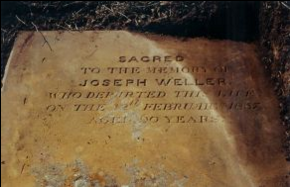
The Weller Brothers' father, Joseph Weller's headstone. Photo courtesy of Richard Weller
Sacred
to the memory of Joseph Weller who departed this life on the 12th of February 1857 aged 90 years |
Joseph Junior became involved in the timber and flax trade in Hokianga on the picturesque northern west coast of New Zealand’s North Island. A trade in native Kauri trees had begun there in 1820, and in 1826 a shipbuilding site named Deptford was established. However, it was with a view to establishing a trading and whaling base in the South Island that the Weller Brothers purchased the 214 ton colonial barque Lucy Ann in August 1831. Captain Owen was enlisted as master and they sailed from Sydney on 21 September. On board was Joseph and Edward Weller, a whaling gang, and the necessities of living and working in an untamed land which included muskets, gun powder, rum, gin, casks of beef, whaling gear and line, and barrels for holding oil.
|
Lucy Ann arrived at Otakau (Otago) in October 1831. When the Weller Bros stepped off their boat and onto a black rock jutting out into the harbour, they hoisted the British Flag and claimed the territory in the name of their King. 100 Years later a bronze tablet was set in that rock, now known as Weller’s Rock, to commemorate the centenary of their arrival.
In the early days of European settlement in New Zealand, anyone wanting to establish themselves a base, or even build a hut, needed the approval of the area’s ruling Maori chief. At this time it was likely the feared cannibal chief Taiaroa who would have given his consent, in return for some form of payment, be it gunpowder or money. |
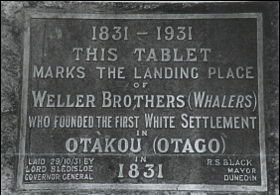
The plaque in Otago Harbour that marks the landing site of the Weller Brothers in 1831
|
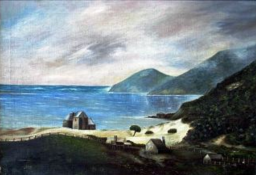
A. Colville's depiction of the Weller Bros station, Otago.
Permission to use this image kindly granted by Otago Settlers Museum, Dunedin, New Zealand.
|
A party of shipbuilders who had been left at Stewart Island in 1826 was enlisted to help the Weller Bros build their station. George remained in Sydney to oversee business operations in the colony. The construction of the station was an ambitious project, with try works, jetties, housing, and storage rooms making up eighty buildings. In a heart breaking twist of fate, no sooner was it completed than the entire station was burned to the ground by a fire which probably started in a neighbouring Maori raupo whare. The calamity of the disaster was matched only in its timing - the very beginning of the whaling season, and that too was a total loss for the hard working entrepreneurial brothers.
When Lucy Ann was next in Sydney Cove she suffered an attempted arson attack, and although a reward was offered, the culprit was never caught. The first shipment of 180 tuns of whale oil from the Weller Bros station reached Sydney on Lucy Ann in November 1833. |
When Lucy Ann was next in Sydney Cove she suffered an attempted arson attack, and although a reward was offered, the culprit was never caught. The first shipment of 180 tuns of whale oil from the Weller Bros station reached Sydney on Lucy Ann in November 1833.
During this time several ships crisscrossed the Tasman Sea for the Weller Bros:
During this time several ships crisscrossed the Tasman Sea for the Weller Bros:
|
Albion - 479 tons, purchased in 1826 by George Weller.
Lucy Ann - 214 tons, purchased from the New South Wales government in 1831 and sold in Australia in 1836. Joseph Weller - 49 tons, purchased from William Cook’s shipbuilding gang which had helped build the original Weller Bros station. Joseph Weller was the first ship built at Stewart Island and the first to be registered by the New South Wales government as New Zealand built. She was launched in 1833. Henry Freeling - Purchased about the beginning of 1837, wrecked at Tautuku on the southern coast, September 1839. Nimrod - Sent to Otago 18 September 1836, returned to Sydney in November with 31 men who had not had a successful season. Harriett - Purchased on March 16 1836 for 1500 pounds, having just arrived in the colony from China. Dublin Packet - Wrecked at Tairei river mouth on 9 June 1839 with the loss of three lives. Mediterranean Packet - Sent 2 March 1836 to Otago with a cargo of stores. |
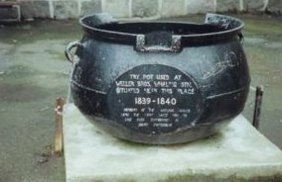
Trypot on display in Timaru, New Zealand
"Try pot used at Weller Bros. Whaling Stn. situated near this place 1839-1840.
Members of the whaling gangs were the first white men to live even temporarly in South Canterbury." Photo courtesy of Richard Weller.
|
Dart - Chartered in Sydney, August 1837 to collect balance of oil from Otago that Henry Freeling had been forced to leave behind.
City of Edinburgh - October 1837 chartered to collect oil from Otago and take to London for sale. As New Zealand was not yet a colony, a large tariff was imposed on the oil as coming from a foreign country, making it unprofitable for the Wellers to sell to the London market direct.Speculator - Purchased in 1840, totally wrecked and its cargo lost thirty miles south of Akaroa, in August the following year. While in Otago, the Weller Brother’s establishment was entwined with the area’s native settlements. Maori men made good whalers, and those on land were kept busy cultivating potatoes. Many European men took Maori wives, including Edward Weller who married Paparu in 1835 and they had a daughter Fanny, or “Hana” in 1836. Paparu died in 1838 and Edward married Chief Taiaroa’s daughter Nikuru in 1839. Nikuru died during the birth of their daughter Nani in 1840. However relations between Europeans and Maori were not always harmonious and on one occasion Edward was kidnapped and ransomed. In 1834 the whalers feared for their lives when 500 warriors returned from a fruitless journey north and took their frustration out on the settlement. Harassed and assaulted and constantly under threat of attack or plunder, it was a harrowing time for the Weller Bros and their men which fortunately passed without loss of life or ship.
In 1835 Joseph Weller succumbed to the same ailment that had prompted his father to seek a new life in the colony five years earlier. Taken by consumption at just 33 years old, Joseph’s body was preserved in a puncheon of rum and taken back to Sydney for burial. This left Edward, only 20 years old, as Manager of the station. After some time Edward’s health began to falter too, under the stress of running the business alone, and he asked his brother George to enlist some assistance. That help came in the form of C.W. Shultze, the Scottish born son of a merchant, who later married Edward’s sister Ann. The nature of the whaling business meant that the Weller Brothers had several small whaling 'bases' set up along the southern coast.
There were three in Otago Harbour, and at least five more between Purakanui in the south, and Go-Ashore on Banks Peninsula.
With word of the Weller Bros successes, other would-be whaling entrepreneurs began to set up competing stations. The indiscriminate slaughter of their resource and shipwrecks that insurers refused to pay out on, meant profits began to decline. On 18 December 1840 Edward sailed to Sydney and never returned to New Zealand. George was also facing financial hardship and following a costly and futile battle to legalise their property rights, he filed for bankruptcy in February 1841. After sovereignty was claimed in New Zealand in 1840, settlers and land speculators were obliged to defend their land titles. The Weller Brothers filed thirteen claims for land acquired in New Zealand but all were thrown out.
Octavious Harwood bought the Weller Bros Otago station in 1841, retaining Schultze as his Manager. George returned to England for a short time in 1849, and died of a stroke in West Maitland in 1875. He was 69 years old. Edward moved to where his father had bought land at Maitland and spent the rest of his days there. In 1893 the area was hit by severe flooding and all attempts to convince Edward to leave his home were in vain. As the waters rose higher, the elderly man climbed into the loft in a bid to survive. Sadly, trapped between the roof and the water, Edward Weller, the last remaining Weller Brother, drowned in his 79th year.
City of Edinburgh - October 1837 chartered to collect oil from Otago and take to London for sale. As New Zealand was not yet a colony, a large tariff was imposed on the oil as coming from a foreign country, making it unprofitable for the Wellers to sell to the London market direct.Speculator - Purchased in 1840, totally wrecked and its cargo lost thirty miles south of Akaroa, in August the following year. While in Otago, the Weller Brother’s establishment was entwined with the area’s native settlements. Maori men made good whalers, and those on land were kept busy cultivating potatoes. Many European men took Maori wives, including Edward Weller who married Paparu in 1835 and they had a daughter Fanny, or “Hana” in 1836. Paparu died in 1838 and Edward married Chief Taiaroa’s daughter Nikuru in 1839. Nikuru died during the birth of their daughter Nani in 1840. However relations between Europeans and Maori were not always harmonious and on one occasion Edward was kidnapped and ransomed. In 1834 the whalers feared for their lives when 500 warriors returned from a fruitless journey north and took their frustration out on the settlement. Harassed and assaulted and constantly under threat of attack or plunder, it was a harrowing time for the Weller Bros and their men which fortunately passed without loss of life or ship.
In 1835 Joseph Weller succumbed to the same ailment that had prompted his father to seek a new life in the colony five years earlier. Taken by consumption at just 33 years old, Joseph’s body was preserved in a puncheon of rum and taken back to Sydney for burial. This left Edward, only 20 years old, as Manager of the station. After some time Edward’s health began to falter too, under the stress of running the business alone, and he asked his brother George to enlist some assistance. That help came in the form of C.W. Shultze, the Scottish born son of a merchant, who later married Edward’s sister Ann. The nature of the whaling business meant that the Weller Brothers had several small whaling 'bases' set up along the southern coast.
There were three in Otago Harbour, and at least five more between Purakanui in the south, and Go-Ashore on Banks Peninsula.
With word of the Weller Bros successes, other would-be whaling entrepreneurs began to set up competing stations. The indiscriminate slaughter of their resource and shipwrecks that insurers refused to pay out on, meant profits began to decline. On 18 December 1840 Edward sailed to Sydney and never returned to New Zealand. George was also facing financial hardship and following a costly and futile battle to legalise their property rights, he filed for bankruptcy in February 1841. After sovereignty was claimed in New Zealand in 1840, settlers and land speculators were obliged to defend their land titles. The Weller Brothers filed thirteen claims for land acquired in New Zealand but all were thrown out.
Octavious Harwood bought the Weller Bros Otago station in 1841, retaining Schultze as his Manager. George returned to England for a short time in 1849, and died of a stroke in West Maitland in 1875. He was 69 years old. Edward moved to where his father had bought land at Maitland and spent the rest of his days there. In 1893 the area was hit by severe flooding and all attempts to convince Edward to leave his home were in vain. As the waters rose higher, the elderly man climbed into the loft in a bid to survive. Sadly, trapped between the roof and the water, Edward Weller, the last remaining Weller Brother, drowned in his 79th year.
|
The Weller Brothers played an important role in New Zealand pre-colonial history, and as well as the rock in Otago Harbour that bears their name, and a plaque in their honour, the exertions and successes of Joseph, George and Edward Weller are immortalised in the folk song “Soon May the Wellerman Come”.
|
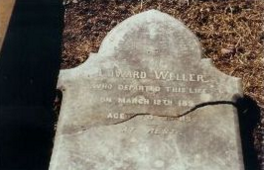
Photo courtesy of Richard Weller
|
The headstone of Edward Weller
Erected in loving memory of Edward Weller who departed this life on March 12th 1893 aged 78 years At Rest |