Allan McLean
Born Wairewa, New Zealand 1904 - 1939
Story by Allan's great-niece.
Story by Allan's great-niece.
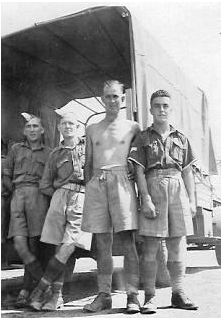
Allan McLean (far left) and his mates serving in the Middle East Forces, WWII
|
Allan McLean, the eldest of three brothers, grew up in Wairewa, a small community in South Otago, New Zealand.
Allan was Dux of his school and after leaving, did casual farm work before buying a small mail delivery business. In 1939 Allan amalgamated his business with several other similar small businesses to form the South Otago Transport Company. Two years later Allan was called up for military service and he joined the Sixth Reserve Motor Transport Company of the New Zealand Army Service Corps. As a driver Allan carried troops and supplies through Egypt, the Palestine, Syria, and Libya. On Allan's 39th birthday, 27 March 1943, in the very last throws of the war in Northern Africa, just outside of Sfax, an enemy bomb hit their convoy, killing Allan and two of his fellow drivers. During almost two years of service he wrote many letters home. Below are a few extracts from some of those letters. |
Letters from Allan McLean, 1941-1943, Middle East
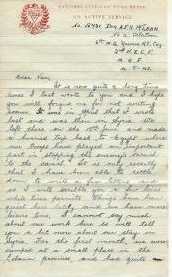
|
26 August 1941
The first week of our voyage was a bit rough and the big liner we were on had a bit of a roll on. Quite a few of the boys were seasick for the first few days, but I felt fine all the time and quite enjoyed the experience of a sea voyage, although it was getting a bit tiresome toward the end and we were glad to get on land again as we had no shore leave at any of the ports we called at. All through the tropics the sea was quite calm and it was very hot below decks. Our battalion had their sleeping quarters well down in the ship and it became too hot and stuffy to sleep in, so we were allowed to sleep on deck certain spaces allotted to us. Most of our training is done before noon owing to the heat and we have a rest period from 2 to 4.30 pm after which a further period of training takes place till 6 pm. Dinner is at 6.30 pm after which we are usually free. It gets dark very quickly over here, about 8 o’clock just now and one misses the long twilight we are used to at home. |
|
31 January 1941
We have been very busy since I last wrote carting forward supplies of all kinds, and have had no further encounters with the enemy. I have done about 4000 miles driving over here now and nearly all on desert so I suppose I can say that I have been broken into it now. We work seven days a week and no time off at Xmas. In fact, we were told that our Xmas dinner is to be postponed till present operations are concluded, so we may get it yet, perhaps. As it happened, I had plenty of good things to eat in parcels just arrived, so was able to celebrate it officially. Perhaps I may be home for next Xmas. Not long ago I hopped out of my blankets in the early hours of the morning, and took refuge in a nearby hole and stayed there for over half an hour, and was it cold? I’ll say it was. We haven’t camped in that area since. It was rather close to one of our supply dumps. |
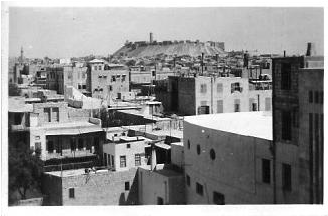
Allepo, Syria. Photograph by Allan McLean
|
19 April 1941
I don’t suppose you will be surprised to hear that we are now in Syria. Have been here about two weeks now and find it rather a pleasant change from the sand and dust of the Lybian Desert. Here, we are surrounded by green fields and snow capped hills. Now that I have left Lybia, I am able to tell you a bit more about it for I have many times traveled back by road and desert routes to as far west as Tobruk and our last six weeks in the desert were spent in the Tobruk area. We were camped about 20 miles from the town and used to be in Tobruk daily for loads of supplies of various kinds, and while on the road one morning, about half a dozen Italian planes swooped down and machine gunned us. We saw them coming in time to stop and leave our trucks and scatter. They passed over once at ground level and sprayed lead broadcast and disappeared. The traffic was thick on the road at that time but no trucks were disabled and only one man was wounded. He stopped three bullets in his back. We soon resumed our journey but keeping a jolly good look-out in case they came back but they did not return and anyway once was quite enough for me. The anti aircraft guns of Tobruk do good work and they put a terrific barrage whenever Jerry comes over.
We left early one morning on our 600 mile journey to Cairo and traveled by way of the desert for three days. The second day brought a dust storm and we did not move for 6 or 7 hours.
I had heard quite a lot about Palestine and what a nice place it is, but it looked even better than I expected to see. The road ran for miles and miles through rich orange groves, the trees hanging thick with ripe oranges and blossom, and in the late afternoon sun it looked as pretty a picture as I have ever seen and one I will long remember. Of course we are besieged by natives offering oranges for sale and I stopped at the gate of one orchard and bought 14 of the largest oranges I have ever seen at a price equal to about one penny each.
I don’t suppose you will be surprised to hear that we are now in Syria. Have been here about two weeks now and find it rather a pleasant change from the sand and dust of the Lybian Desert. Here, we are surrounded by green fields and snow capped hills. Now that I have left Lybia, I am able to tell you a bit more about it for I have many times traveled back by road and desert routes to as far west as Tobruk and our last six weeks in the desert were spent in the Tobruk area. We were camped about 20 miles from the town and used to be in Tobruk daily for loads of supplies of various kinds, and while on the road one morning, about half a dozen Italian planes swooped down and machine gunned us. We saw them coming in time to stop and leave our trucks and scatter. They passed over once at ground level and sprayed lead broadcast and disappeared. The traffic was thick on the road at that time but no trucks were disabled and only one man was wounded. He stopped three bullets in his back. We soon resumed our journey but keeping a jolly good look-out in case they came back but they did not return and anyway once was quite enough for me. The anti aircraft guns of Tobruk do good work and they put a terrific barrage whenever Jerry comes over.
We left early one morning on our 600 mile journey to Cairo and traveled by way of the desert for three days. The second day brought a dust storm and we did not move for 6 or 7 hours.
I had heard quite a lot about Palestine and what a nice place it is, but it looked even better than I expected to see. The road ran for miles and miles through rich orange groves, the trees hanging thick with ripe oranges and blossom, and in the late afternoon sun it looked as pretty a picture as I have ever seen and one I will long remember. Of course we are besieged by natives offering oranges for sale and I stopped at the gate of one orchard and bought 14 of the largest oranges I have ever seen at a price equal to about one penny each.
|
11 December 1941
I am not able to tell you anything about my work except to say that I have been driving most of the time over the desert. Things were rather exciting for a while and I managed to come through with a whole skin, though I lost all my belongings and just had the clothes I wore. I felt a bit sore over losing everything, but I suppose I must be thankful that I am still fit and well. The weather here has changed rather suddenly, and is now rather cold and windy with a bit of sand flying about. It gets into the food, into the blankets, and one just has to get used to it, and hope it will soon blow over. I have quite a comfortable little dugout from which I can look out over the sea. |
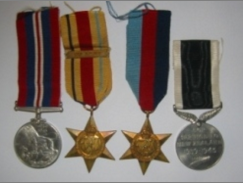
Allan McLean's medals
|
07 January 1942
The weather just now is not the best. Cold winds are the rule with an occasional shower of rain, but more often showers of dust, and you can imagine the mess everything gets in especially when it starts to rain in a dust storm. We have on different occasions been traveling in a dust storm and it is very easy to lose all sense of direction for even the sun disappears from view at times but we have always managed to reach our destination although sometimes considerably delayed.
We saw our troops in action for one day only, and were under fire ourselves on that occasion. My mate and I lay beside our truck all that afternoon while both ours and enemy shells whistled to and fro overhead and bullets were kicking up the dust all around us, and believe me, I never hugged the ground so close in all my life as I did that day, but luckily neither my mate nor I were touched, nor was the truck hit. We camped there that night and shifted early next morning. It was a day or two after that when I lost my truck as mentioned in my last letter.
08 June 1942
Things are still quiet here, rather different from the desert at the moment. I have no desire to see that desert again. We were fortunate in leaving there before the weather became too hot and the Tobruck water is far from pleasant, being very salty. We have shifted around a bit since I last wrote, and we have seen quite a bit of the country. The harvest is ripe now and everywhere may be seen natives in the fields along the roads busy cutting the crops with sickles. Most of this work seems to be done by women and they toil from daylight to dark. The methods of threshing too are very ancient, cattle being used to tramp the grain out of the straw. About four bullocks are coupled together and driven round and round on the circular heap of straw.
I don’t remember whether I mentioned in my last letter that malaria is very prevalent in this country and every precaution is taken to avoid getting bitten by mosquitoes. We live in barracks here and have a fairly easy time, being able to visit town frequently in the evenings and go to the pictures, rather a pleasant change from the quiet life of the western desert where we had to make our own fun, except when Jerry came and gave us a little entertainment in the shape of a low flying attack, and sprayed us with bullets.
27 February 1943
I must thank you very much for sending the cake. It arrived only about a fortnight ago. This delay was no doubt due to the fact that we were traveling westward all the time to Tripoli, and it was some time before the parcels caught up on us. The cake was in splendid condition and I can assure you that it was thoroughly enjoyed by my mates and I. That mail brought me five cakes, so we were doing rather well while it lasted, which was not very long I can tell you. They were a real treat I can tell you after being so long on hard rations during our long desert journey. You will have heard and read in the papers account of our long journey through the desert of Tripolitania. It was quite a quiet trip, we did not see any action, although one day a few shells from the retreating army fell not so far away. The leading troops saw more of it, and we could hear the tanks shooting out ahead of us. We had no attacks from the air, but saw a few some distance away. Our planes were seen in large numbers most of the way and it is due to them that we were able to proceed in comparative safety, although the men dug slit trenches whenever we stopped just in case. No meals are obtainable in the town but the Y.M.C.A. put on free cups of tea at certain periods of the day. They have secured the use of a nice building and have it nicely furnished and set out in writing rooms and a comfortable lounge. The main attraction just now is daily afternoon concerts by the Kiwi Concert Party in a large theatre and it is always packed to the doors. About three weeks ago, we were inspected by Britain’s Prime Minister at a parade of the N.Z. Division near Tripoli and he spoke to us and thanked us for the part we had played in the battle for Egypt.
This was to be the last letter from Allan McLean.
The end of the war
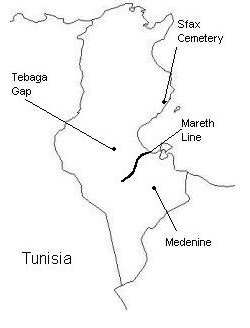
After losing Tripoli in 1943, the Axis forces withdrew to their last stronghold in Africa, Tunisia, where they consolidated behind the Mareth Line. In response, the allied forces Eighth Army established a base about 20 miles away at Medenine. There, a hard fought campaign on land and in the air saw the Eighth Army, with much help from the Maori Battalion, destroy any hope Hitler’s field marshal Erwin Rommel “the Desert Fox” had of hanging onto ground in Northern Africa. From Medenine, the RMT drivers, including Allan McLean, were ordered to take a left hook and head to Tebaga Gap, bypassing enemy forces behind the Matmata Hills.
“For New Zealand Corps the balloon went up at 6 pm on 19 March. Drivers climbed into their seats, the infantry settled down beneath the canopies, and the move began. On a nine vehicle front, with 50 yards between vehicles, and traveling at a speed of eight miles in the hour, New Zealand Corps went forward 30 to 40 miles over sand dunes and wadis clear and sharp and lonely under a bright moon. When the sun returned and the march resumed, drivers looked out in awe to a desert horizon crawling with vehicles – 6000 of them, if one could only see them all. In the vehicles were 27,000 men; the New Zealanders numbered 14,500.” (Henderson, p.257)
The weather just now is not the best. Cold winds are the rule with an occasional shower of rain, but more often showers of dust, and you can imagine the mess everything gets in especially when it starts to rain in a dust storm. We have on different occasions been traveling in a dust storm and it is very easy to lose all sense of direction for even the sun disappears from view at times but we have always managed to reach our destination although sometimes considerably delayed.
We saw our troops in action for one day only, and were under fire ourselves on that occasion. My mate and I lay beside our truck all that afternoon while both ours and enemy shells whistled to and fro overhead and bullets were kicking up the dust all around us, and believe me, I never hugged the ground so close in all my life as I did that day, but luckily neither my mate nor I were touched, nor was the truck hit. We camped there that night and shifted early next morning. It was a day or two after that when I lost my truck as mentioned in my last letter.
08 June 1942
Things are still quiet here, rather different from the desert at the moment. I have no desire to see that desert again. We were fortunate in leaving there before the weather became too hot and the Tobruck water is far from pleasant, being very salty. We have shifted around a bit since I last wrote, and we have seen quite a bit of the country. The harvest is ripe now and everywhere may be seen natives in the fields along the roads busy cutting the crops with sickles. Most of this work seems to be done by women and they toil from daylight to dark. The methods of threshing too are very ancient, cattle being used to tramp the grain out of the straw. About four bullocks are coupled together and driven round and round on the circular heap of straw.
I don’t remember whether I mentioned in my last letter that malaria is very prevalent in this country and every precaution is taken to avoid getting bitten by mosquitoes. We live in barracks here and have a fairly easy time, being able to visit town frequently in the evenings and go to the pictures, rather a pleasant change from the quiet life of the western desert where we had to make our own fun, except when Jerry came and gave us a little entertainment in the shape of a low flying attack, and sprayed us with bullets.
27 February 1943
I must thank you very much for sending the cake. It arrived only about a fortnight ago. This delay was no doubt due to the fact that we were traveling westward all the time to Tripoli, and it was some time before the parcels caught up on us. The cake was in splendid condition and I can assure you that it was thoroughly enjoyed by my mates and I. That mail brought me five cakes, so we were doing rather well while it lasted, which was not very long I can tell you. They were a real treat I can tell you after being so long on hard rations during our long desert journey. You will have heard and read in the papers account of our long journey through the desert of Tripolitania. It was quite a quiet trip, we did not see any action, although one day a few shells from the retreating army fell not so far away. The leading troops saw more of it, and we could hear the tanks shooting out ahead of us. We had no attacks from the air, but saw a few some distance away. Our planes were seen in large numbers most of the way and it is due to them that we were able to proceed in comparative safety, although the men dug slit trenches whenever we stopped just in case. No meals are obtainable in the town but the Y.M.C.A. put on free cups of tea at certain periods of the day. They have secured the use of a nice building and have it nicely furnished and set out in writing rooms and a comfortable lounge. The main attraction just now is daily afternoon concerts by the Kiwi Concert Party in a large theatre and it is always packed to the doors. About three weeks ago, we were inspected by Britain’s Prime Minister at a parade of the N.Z. Division near Tripoli and he spoke to us and thanked us for the part we had played in the battle for Egypt.
This was to be the last letter from Allan McLean.
The end of the war
After losing Tripoli in 1943, the Axis forces withdrew to their last stronghold in Africa, Tunisia, where they consolidated behind the Mareth Line. In response, the allied forces Eighth Army established a base about 20 miles away at Medenine. There, a hard fought campaign on land and in the air saw the Eighth Army, with much help from the Maori Battalion, destroy any hope Hitler’s field marshal Erwin Rommel “the Desert Fox” had of hanging onto ground in Northern Africa. From Medenine, the RMT drivers, including Allan McLean, were ordered to take a left hook and head to Tebaga Gap, bypassing enemy forces behind the Matmata Hills.
“For New Zealand Corps the balloon went up at 6 pm on 19 March. Drivers climbed into their seats, the infantry settled down beneath the canopies, and the move began. On a nine vehicle front, with 50 yards between vehicles, and traveling at a speed of eight miles in the hour, New Zealand Corps went forward 30 to 40 miles over sand dunes and wadis clear and sharp and lonely under a bright moon. When the sun returned and the march resumed, drivers looked out in awe to a desert horizon crawling with vehicles – 6000 of them, if one could only see them all. In the vehicles were 27,000 men; the New Zealanders numbered 14,500.” (Henderson, p.257)
|
On March 21, within site of Tebaga Gap, Allan and his fellow RMT drivers watched as the Eighth Army’s armour, artillery, and infantry moved towards enemy positions across the six mile gap. For days battles raged and many thousands of axis prisoners were captured. However, their weakening defenses were bolstered by the arrival of two German divisions. The main attack came on March 26, witnessed by the RMT drivers and General Freyberg:
“ In an instant the attack developed, and 150 tanks of the 8 Armoured Brigade and three battalions of infantry appeared as from nowhere advancing in the natural ‘smoke’ screen provided by the dust storms. The roar of bombers and fighters ahead of our advance merged with the intense barrage of bursting shells. Following close behind the advancing barrage came waves of Sherman tanks, carriers, infantry and sappers on foot, preceded by three squadrons of Crusader tanks. Behind the assault of the 2 New Zealand Division, coming down the forward slopes just in the rear of our front line, were another 150 tanks of the 1 Armoured Division followed by their motorized infantry in nine columns of lorries. It was the most awe-inspiring spectacle of modern warfare.” (Henderson, p.259) |
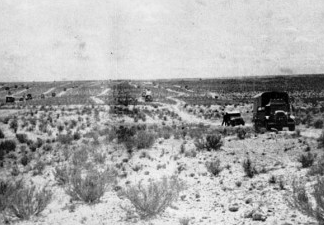
New Zealand Corps on the left hook to Tabega Gap - as seen by the Divisional Cavalry advanced guard.
Permission to use the image kindly granted by the
New Zealand Ministry of Culture and Heritage.
|
It was during this battle on March 27 1943 that New Zealand’s Lieutenant Te M. N. Ngarimu won the V.C.
Later that day, as the RMT drove across the battlefield through wreckage and past thousands of prisoners and many dead soldiers, they must have felt an enormous sense of relief. Not only had their troops won the battle and ended axis resistance in Northern Africa, but the RMT drivers had come through the worst of it without further casualty. Advancing up the road to El Hamma, while the Eighth Army mopped up the remaining pockets of enemy, 3 Platoon 6 RMT, known as the ‘moya’ or water service supply company, were struck by one of the last bursts of shelling and Driver Allan McLean was killed.
Later that day, as the RMT drove across the battlefield through wreckage and past thousands of prisoners and many dead soldiers, they must have felt an enormous sense of relief. Not only had their troops won the battle and ended axis resistance in Northern Africa, but the RMT drivers had come through the worst of it without further casualty. Advancing up the road to El Hamma, while the Eighth Army mopped up the remaining pockets of enemy, 3 Platoon 6 RMT, known as the ‘moya’ or water service supply company, were struck by one of the last bursts of shelling and Driver Allan McLean was killed.
|
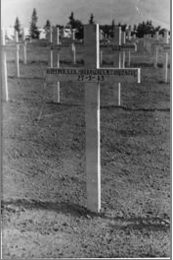
Driver Allan F.R. McLean
Service No 18721 Division 3 Platoon 6th (N.Z.) Reserve M.T. Company 2nd N.Z.E.F. Middle East Forces Buried Sfax cemetery Tunisia, Row B Grave 11. Sfax war cemetery lies two kilometres south of the town, on the road to Gabes. It contains the graves of fallen soldiers from the battles of Medenine, the Mareth Line, and Wadi Akarit. |
|
|
Sources:
Private family history documents and notes, and the letters of A.F.R McLean, 1941-1943, Middle East. Henderson, Jim. RMT Official History of the 4th and 6th Reserve Mechanical Transport Companies, 2 NZEF. Wellington, NZ: Department of Internal Affairs, 1954 Do you have an ancestor that served in a war? If you'd like to share a little about them, contact us, so we can help build a lasting memorial for your ancestor to honour the sacrifice they made. |
|